
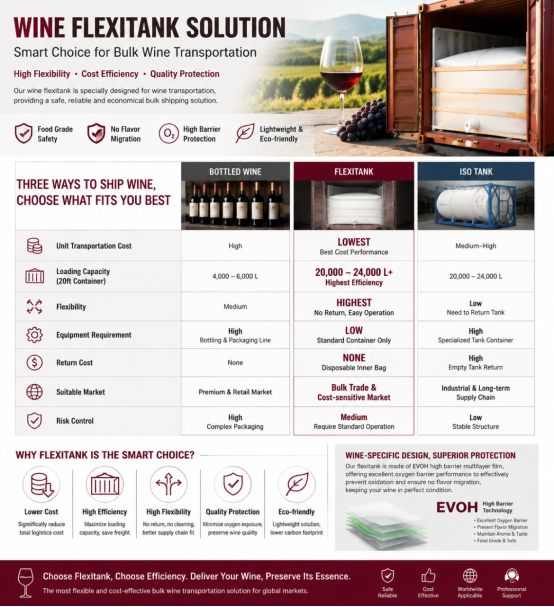
In international wine trade, the most common transportation methods include bottled shipping, flexitank bulk shipping, and ISO tank container shipping. Each method differs significantly in cost structure, operational flexibility, and applicable market segments, and should be selected based on product positioning and customer requirements.
Bottled wine shipping is the most traditional method, where wine is fully bottled, labeled, and packaged before transportation as finished goods. It is mainly used for premium brands and retail markets. While it offers complete product presentation and strong branding value, it comes with high packaging, labor, and logistics costs, making the overall supply chain relatively complex.
ISO tank container shipping uses stainless steel tanks for liquid transport. It offers high structural stability, reusability, and strong safety performance, making it suitable for industrial applications or long-term stable supply chains. However, due to high equipment costs and the need for return logistics, its operational flexibility is relatively limited.
In comparison, flexitank bulk shipping demonstrates significant advantages in large-scale wine transportation. It utilizes standard 20-foot containers and can carry approximately 20,000–24,000 liters of wine without requiring returnable container assets, greatly reducing logistics costs. In addition, flexitank systems require minimal infrastructure and offer simple operation, significantly improving supply chain efficiency and flexibility.
In modern international wine trade, flexitank transportation has become a preferred solution for medium- to low-end wines and bulk export markets due to its strong cost advantage, high loading efficiency, and operational flexibility. Bottled shipping and ISO tank transportation, on the other hand, remain more suitable for premium retail markets and high-standard industrial supply chains respectively.
Overall, while each method serves different market needs, flexitank transportation offers the most competitive balance of cost efficiency and operational flexibility in bulk wine international logistics.
Address: 1 Yunhai Road, Tongji Industrial Park, Jimo City, Qingdao, Shandong Province, China
Tel: +86-532-82525577 +86-15506393279
E-mail: info@cnflexitank.com

Copyright © 2020 Qingdao Zhongxiang Packaging Co,.Ltd., All Rights Reserved. Powered by HiCheng
